

Editorial disclosure:

WireRanked may earn a commission when you click links on this page. Our recommendations are editorially reviewed, and affiliate relationships do not guarantee placement or ranking.

Best CRM for Sales Teams (2026)

Six CRMs ranked for dedicated sales teams, from focused pipeline execution to complex territories and outbound calling.

By WireRanked Editorial Team · Updated August 3, 2026

Which CRM Is Best for You? Choose Your Preference.

Your Route

Pipedrive

Best for focused pipeline execution. Pipedrive keeps deals, next actions, email, and forecasts in one sales workflow.

A ranked sequence of software interface cards

WireRanked buying guide

Best CRM for Sales Teams (2026)

Six CRMs ranked for dedicated sales teams, from focused pipeline execution to complex territories and outbound calling.

By WireRanked Editorial Team · Updated Aug 3, 2026
In this articleJump to a section

At a glance

Compare the top picks

Swipe to compare all columns

RankLogoProductWireRankBest forStarting priceStandoutAction
#2Salesforce Sales Cloud9.2 / 10complex governance and territories$25/user/month for Starter SuiteLast verified July 26, 2026Best for complex or multi-team sales operationsVisit Salesforce Sales Cloud
#3Close8.8 / 10high-volume outbound communication$35/user/month billed annually for EssentialsLast verified July 26, 2026Best for outbound sales teamsVisit Close
#4Freshsales8.5 / 10lower-cost communication and automation$9/user/month billed annually for GrowthLast verified July 26, 2026Best value for built-in communication and automationVisit Freshsales
#5HubSpot Smart CRM8.3 / 10shared marketing and service data$0 free CRMLast verified July 26, 2026Best for a cross-functional customer platformVisit HubSpot Smart CRM
#6Zoho CRM8.0 / 10low-cost deep customizationFree for 3 users; Standard $14/user/month annuallyLast verified July 28, 2026Best for budget-conscious customizationVisit Zoho CRM
#3

Best for outbound sales teams

Close

Best for
high-volume outbound communication
Starting price
$35/user/month billed annually for EssentialsLast verified July 26, 2026
Our rating
8.8/10WireRanked score
Visit Close
#4

Best value for built-in communication and automation

Freshsales

Best for
lower-cost communication and automation
Starting price
$9/user/month billed annually for GrowthLast verified July 26, 2026
Our rating
8.5/10WireRanked score
Visit Freshsales
#5

Best for a cross-functional customer platform

HubSpot Smart CRM

Best for
shared marketing and service data
Starting price
$0 free CRMLast verified July 26, 2026
Our rating
8.3/10WireRanked score
Visit HubSpot Smart CRM
#6

Best for budget-conscious customization

Zoho CRM

Best for
low-cost deep customization
Starting price
Free for 3 users; Standard $14/user/month annuallyLast verified July 28, 2026
Our rating
8.0/10WireRanked score
Visit Zoho CRM
01

Best overall for a focused sales team

Pipedrive

Pipedrive puts the rep’s pipeline and next activity at the center. Growth is the practical team baseline, while Premium adds routing, scoring, contracts, and tighter controls.
9.4/10WireRanked score
Visit Pipedrive
Best forfocused pipeline executionStarting price$14/seat/month billed annually for LiteLast verified July 28, 2026Editorial callBest overall for a focused sales team
Pipedrive product interface
Pipedrive product interface · Official vendor image

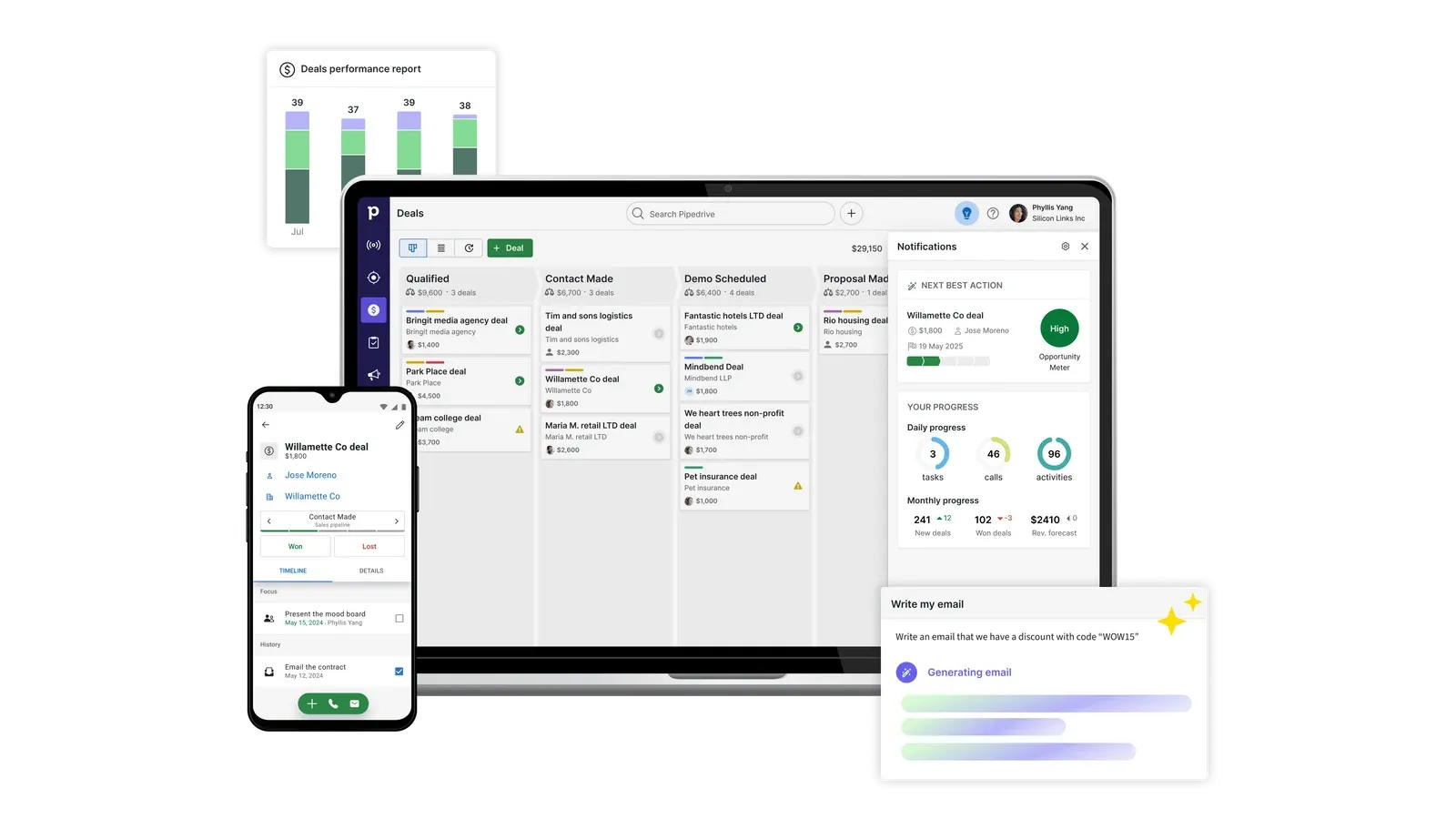
Pipedrive ranks first because it keeps the daily operating unit—the deal and its next activity—visible to reps and managers. Pipelines, team filters, stale-deal signals, goals, email history, automation, and forecasts support the weekly sales meeting without requiring the company to implement a broader enterprise platform.

Current official annual pricing is $14 per seat monthly for Lite, $39 for Growth, $59 for Premium, and $79 for Ultimate. Growth is the practical team baseline because it adds full email sync and tracking, automations, sequences, subscriptions, forecasts, scheduling, and contact timelines. Premium adds routing, scoring, enrichment, contracts, e-signatures, stronger fields, and permissions.

Salesforce has the higher ceiling. Pipedrive wins the broad sales-team recommendation because a straightforward B2B team can reach value faster and operate with less administration. Add-ons for lead generation, projects, campaigns, visitors, and documents can narrow the price advantage, so price the complete workflow.

For rollout, preserve the stage definitions that managers already trust, then simplify fields and automations rather than copying every legacy customization. A representative pilot should prove email synchronization, next-action compliance, ownership changes, reporting, and the weekly forecast. That keeps Pipedrive’s adoption advantage intact instead of recreating an enterprise implementation inside a focused CRM.

Implementation: easy for a conventional sales process. Best for: a sales leader running one or several focused pipelines. Skip this if: complex territories, business units, approvals, or cross-functional lifecycle management dominate. Key tradeoff: faster execution with a lower governance ceiling. Final verdict: choose Pipedrive when sales discipline matters more than enterprise breadth.

Key tradeoff: Useful sales-team automation starts above Lite
Annual plan prices
Lite $14, Growth $39, Premium $59, Ultimate $79 per seat/month · SourceChecked July 28, 2026
Annual payments
$168, $468, $708, and $948 per seat/year respectively · SourceChecked July 28, 2026
Trial
14 days with no credit card required · SourceChecked July 28, 2026
02

Best for complex or multi-team sales operations

Salesforce Sales Cloud

Salesforce has the strongest ceiling here, but a sales team should expect the practical plan to cost far more than the $25 Starter headline once it needs forecasting and advanced controls.
9.2/10WireRanked score
Visit Salesforce Sales Cloud
Best forcomplex governance and territoriesStarting price$25/user/month for Starter SuiteLast verified July 26, 2026Editorial callBest for complex or multi-team sales operations
Salesforce Sales Cloud product interface
Salesforce Sales Cloud product interface · Official vendor image

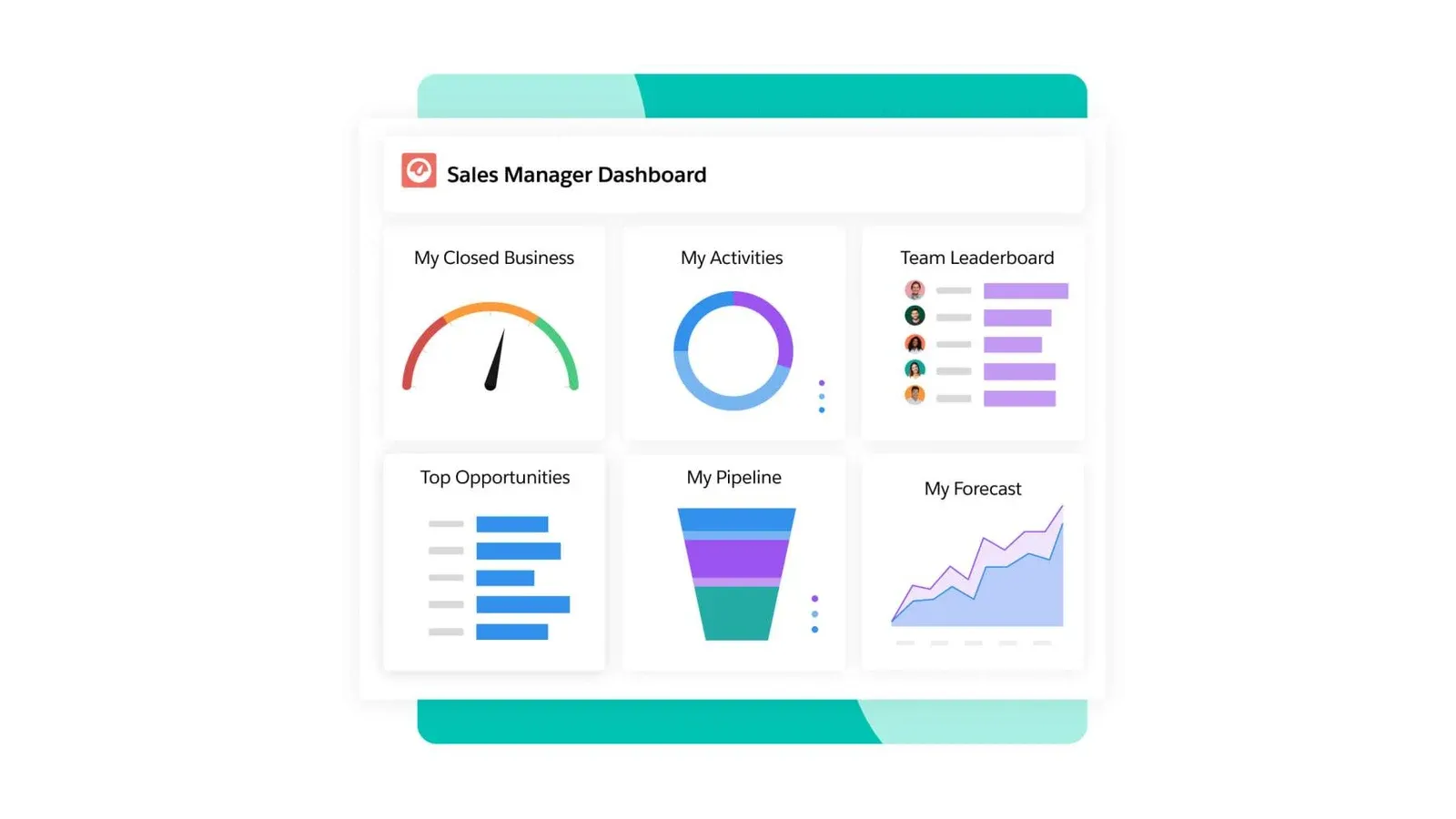
Salesforce is the stronger operating system for complex sales organizations. It supports lead assignment, multiple processes, opportunity teams, forecasts, territories, advanced reporting, pipeline inspection, deal intelligence, integrations, and extensive customization across regions or product lines.

Starter Suite is $25 per user monthly. Pro is $100 billed annually and adds greater automation, customization, quoting, and forecasting; Enterprise is $175 and adds advanced pipeline management, deal insights, conversation intelligence, and more AI capability. The correct comparison begins with the lowest edition that runs the real process, not the Starter headline.

Salesforce ranks second because many dedicated sales teams do not need its entire operating surface. The order reverses when governance, territories, integrations, approval paths, or multi-team reporting are non-negotiable. Include implementation, administration, support, AI, and adjacent products in the cost model.

A credible deployment needs an accountable process owner, a data model, migration rules, integration testing, permission design, reporting definitions, training, and post-launch administration. Those are not merely consulting extras; they determine whether Salesforce becomes a truthful operating system or an expensive collection of fields. The platform earns its complexity only when the organization will govern it.

Implementation: advanced. Best for: multi-team sales operations with a revenue-operations owner. Skip this if: nobody owns CRM administration or one pipeline covers the process. Key tradeoff: unmatched control with more cost and operational overhead. Final verdict: choose Salesforce when complexity is real today, not hypothetical.

Key tradeoff: Forecasting and meaningful customization push buyers above Starter

Starting price
$25/user/month for Starter Suite · SourceChecked July 26, 2026
Key plan limit
Pro is $100/user/month annually; Enterprise is $175; Unlimited is $350. · SourceChecked July 26, 2026
03

Best for outbound sales teams

Close

Close is the strongest specialist for outbound execution. Essentials centralizes communication, but Growth is the real automation tier and costs $99 per user monthly on annual billing.
8.8/10WireRanked score
Visit Close
Best forhigh-volume outbound communicationStarting price$35/user/month billed annually for EssentialsLast verified July 26, 2026Editorial callBest for outbound sales teams
Close product interface
Close product interface · Official vendor image

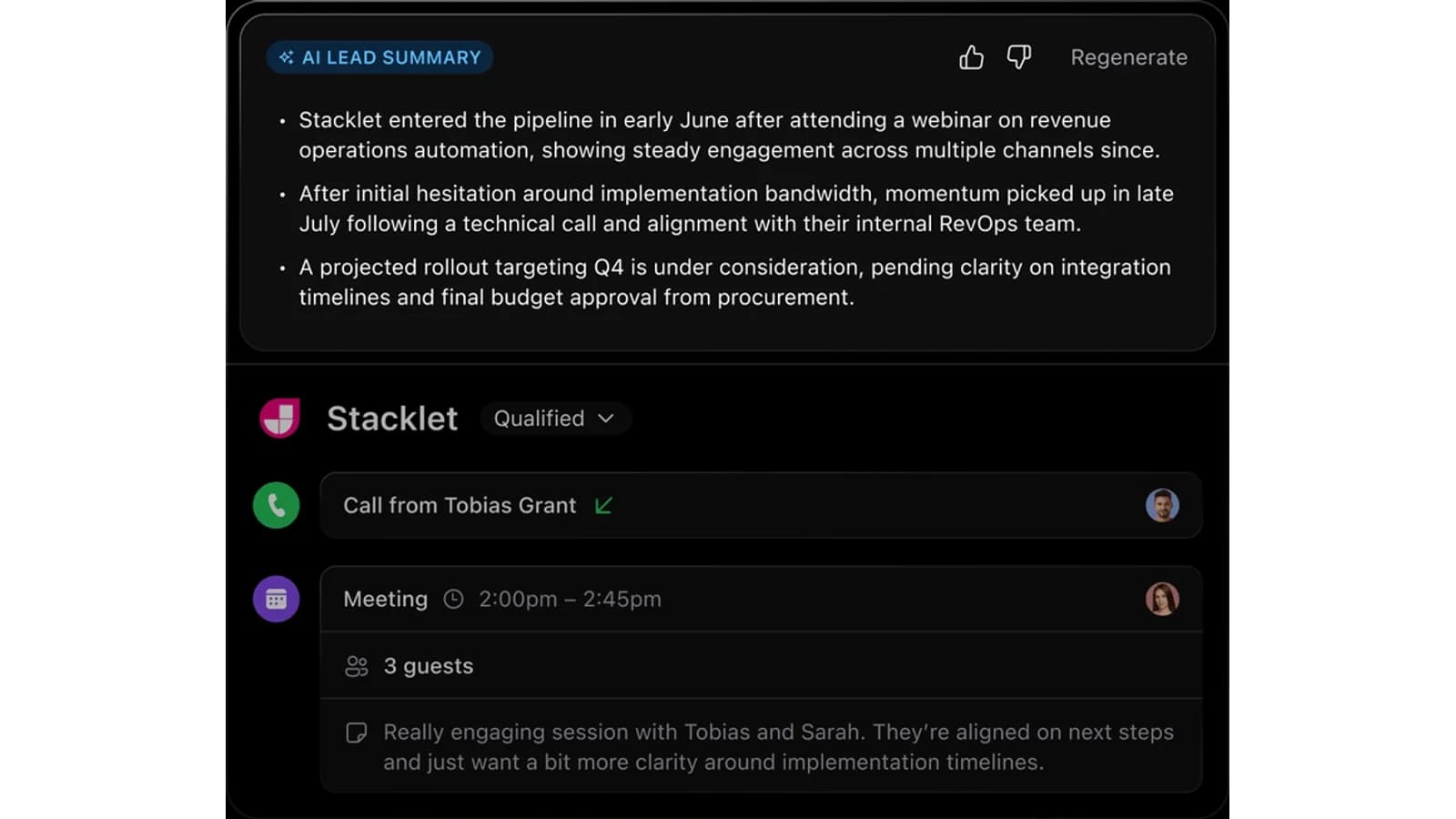
Close turns the CRM into the communication workspace by combining email, calling, SMS, tasks, inbox, contacts, leads, and opportunities. That coherence matters when managers measure activity, response, follow-up, call execution, and pipeline conversion together.

Essentials starts at $35 per user monthly billed annually and includes team collaboration and communications but no workflows. Growth is $99 and adds automated workflows, power dialing, custom activities, and bulk email. Scale is $139 and adds roles, visibility rules, predictive dialing, longer recording retention, and coaching.

Calling, numbers, SMS, and extra AI can add usage charges. Close is economical when it replaces a general CRM, dialer, and sequencing stack; it is expensive when outbound is not the operating model. The team should already have lists, messaging, ownership, and a daily prospecting cadence.

Migration planning should include phone-number setup, call consent and recording rules, mailbox configuration, sequence ownership, opt-out handling, historical activities, and reporting continuity. A short pilot can reach value quickly when those inputs exist. If the current problem is weak messaging or poor lead quality, replacing the CRM will mostly make ineffective outreach happen faster.

Implementation: moderate. Best for: phone-, email-, and SMS-heavy outbound teams. Skip this if: account hierarchies or lifecycle management matter more than communications. Key tradeoff: consolidated execution at specialist pricing. Final verdict: choose Close when reps live in outbound channels all day.

Key tradeoff: Automated workflows require the expensive Growth tier

Starting price
$35/user/month billed annually for Essentials · SourceChecked July 26, 2026
Key plan limit
Growth is $99 annually ($109 monthly); Scale is $139 annually ($149 monthly). Workflows and power dialer start on Growth. · SourceChecked July 26, 2026
04

Best value for built-in communication and automation

Freshsales

Freshsales offers the clearest value ladder here: $9 Growth covers the working basics, while $39 Pro adds the scoring, sequences, territories, and deal insight most managed teams eventually request.

8.5/10WireRanked score
Visit Freshsales
Best forlower-cost communication and automationStarting price$9/user/month billed annually for GrowthLast verified July 26, 2026Editorial callBest value for built-in communication and automation
Freshsales product interface
Freshsales product interface · Official vendor image

Freshsales combines pipeline management with chat, email, phone, lifecycle stages, templates, fields, and basic workflows. Growth costs $9 per user monthly billed annually, making it the lowest verified paid team entry here; the free plan supports up to three users.

Pro costs $39 annually and adds scoring, deal insights, custom activities, territories, and sequences. Enterprise costs $59 and adds forecasting insights, field permissions, custom modules, a sandbox, and audit logs. Branded documents and some Freddy AI usage are separate add-ons.

The upgrade is the main buying decision. Growth is a credible operating plan for a small team, but common manager requests push the account to Pro. Map scoring, sequences, routing, territory, and reporting requirements before choosing on the $9 headline.

Time-to-value should be measured on the actual communication workflow: connect representative mailboxes, route leads, place a call, trigger a workflow, and run the manager view. That test also exposes which requirements belong to Pro and which add-ons create separate cost. A low entry price is useful only if the working team can remain on that edition.

Implementation: easy to moderate. Best for: a cost-conscious small or midsize team wanting communications and CRM together. Skip this if: deep enterprise governance is required. Key tradeoff: strong entry value followed by a meaningful Pro jump. Final verdict: choose Freshsales when integrated communication and cost matter equally.

Key tradeoff: Managed-team features jump from $9 Growth to $39 Pro
Annual paid prices
Growth $9, Pro $39, Enterprise $59 per user/month · SourceChecked July 28, 2026
Free plan
Free for up to 3 users · SourceChecked July 28, 2026
05

Best for a cross-functional customer platform

HubSpot Smart CRM

HubSpot is the best cross-functional foundation and can start free. It ranks lower for a sales-only buyer because the exact premium configuration, seats, Hubs, onboarding, and credits need active modeling.
8.3/10WireRanked score
Visit HubSpot Smart CRM
Best forshared marketing and service dataStarting price$0 free CRMLast verified July 26, 2026Editorial callBest for a cross-functional customer platform
HubSpot Sales Hub product interface
HubSpot Smart CRM product interface · Official vendor image

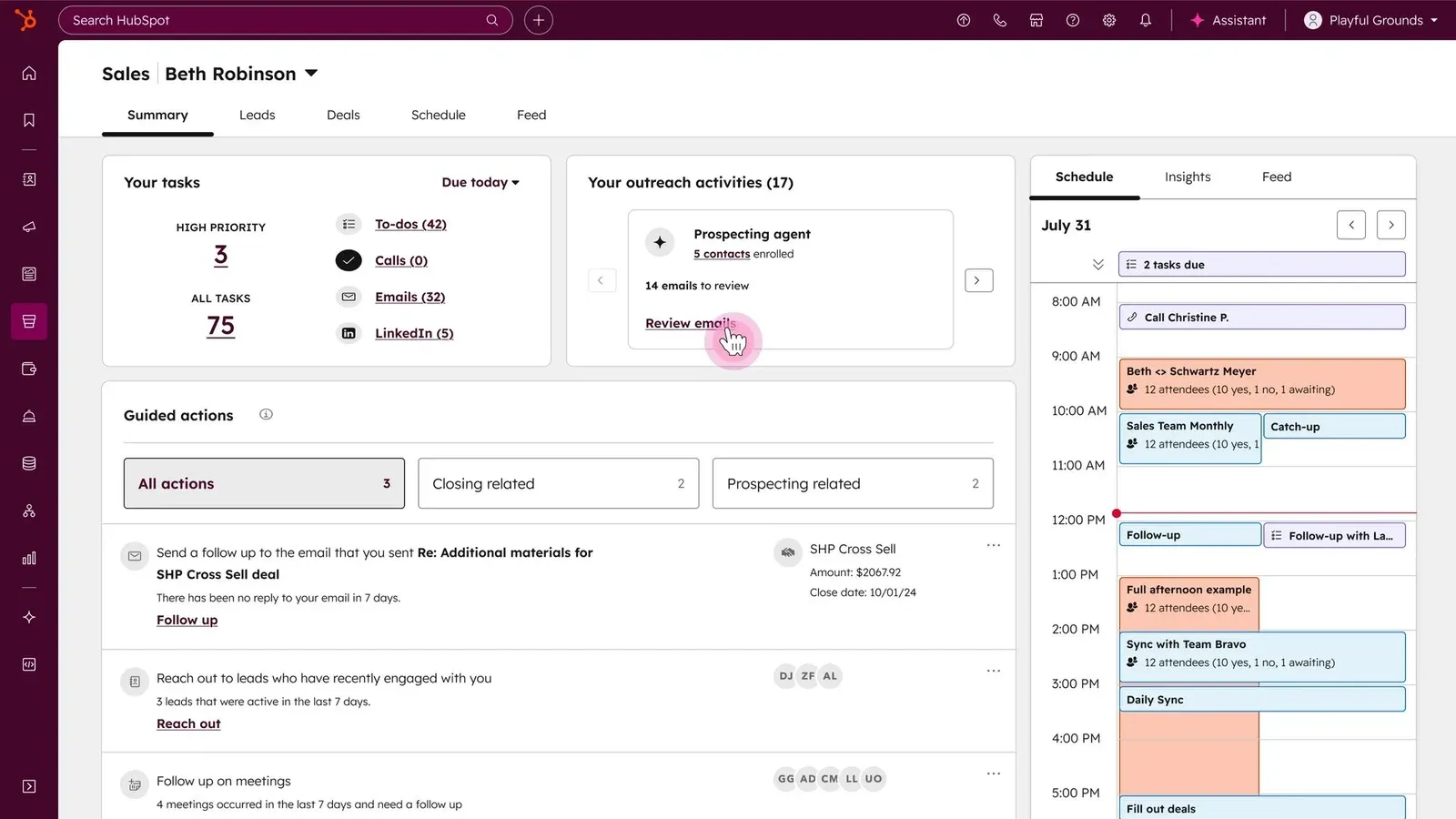
HubSpot is strongest when sales shares the customer record with marketing and service. Forms, campaigns, sales activity, support interactions, content, and operations can build on the same CRM, beginning with a free product.

The buying challenge is future configuration. Price the intended sales seats, automation, sequences, reporting, Hubs, onboarding, contact tiers, and HubSpot Credits in the current tool. Free entry is real, but there is no single headline amount that represents every paid cross-functional setup.

HubSpot ranks lower for a sales-only buyer because Pipedrive is more focused and easier to price. It moves higher when demand generation, service, and lifecycle reporting must operate on one platform. The broader value proposition can justify the procurement work, but only if those functions will use it.

Migration complexity depends less on contact import than on the number of teams and Hubs sharing the record. Define lifecycle stages, marketing-contact rules, sales ownership, service handoffs, permissions, and reporting before enabling automation. A staged rollout can deliver free-CRM value quickly while preventing an accidental paid architecture from growing without an owner.

Implementation: easy free start, moderate to advanced for a multi-Hub rollout. Best for: sales organizations sharing data with marketing and service. Skip this if: a narrow sales system and simple paid ladder are priorities. Key tradeoff: cross-functional breadth complicates future cost. Final verdict: choose HubSpot when the shared customer platform is the goal.

Key tradeoff: Paid pricing cannot be reduced to one trustworthy headline in this fetch

Free CRM
Ongoing free CRM available · SourceChecked July 28, 2026
Paid configuration
Price varies by selected Hubs, seats, onboarding, contacts, and credits · SourceChecked July 28, 2026
06

Best for budget-conscious customization

Zoho CRM

Zoho combines a capable three-user free edition with a deep paid feature ladder. It is a strong budget alternative, but the edition matrix and localized pricing make procurement less clean.
8.0/10WireRanked score
Visit Zoho CRM
Best forlow-cost deep customizationStarting priceFree for 3 users; Standard $14/user/month annuallyLast verified July 28, 2026Editorial callBest for budget-conscious customization
Zoho CRM with Zia product interface
Zoho CRM product interface · Official vendor image

Zoho CRM provides a capable free edition for up to three users, including leads, deals, workflows, reports, mobile apps, tasks, calls, imports, exports, reminders, templates, and API access. Confirmed U.S. annual prices are $14 for Standard, $23 for Professional, $40 for Enterprise, and $52 for Ultimate per user monthly.

Standard adds email integration, calling, multiple pipelines, forms, forecasts, enrichment, and custom modules. Professional adds process and inventory management. Enterprise adds territories, approval processes, sandboxing, custom functions, portals, and deeper AI capability.

The feature runway is broad, but so is the edition matrix. Teams should map required workflow, reporting, storage, integration, and governance features to a tier before setup. Zoho can control subscription spend, yet procurement and administration demand more ownership than Pipedrive or Freshsales.

A phased deployment should begin with one pipeline, clean ownership, required fields, email integration, and the reports used in the weekly meeting. Add custom modules, territories, approvals, portals, or broader Zoho products only after the core data stays reliable. This approach reduces the risk that low subscription cost is offset by an overbuilt configuration nobody maintains.

Implementation: moderate to advanced. Best for: teams willing to configure a broad CRM on a controlled budget. Skip this if: a simple ladder and minimal administration matter most. Key tradeoff: low entry cost with high configuration choice. Final verdict: choose Zoho when customization capacity is worth the setup burden.

Key tradeoff: Free plan stops at three users

Free edition
Up to 3 users · SourceChecked July 28, 2026
Annual U.S. prices
Standard $14, Professional $23, Enterprise $40, Ultimate $52 per user/month · SourceChecked July 28, 2026
In this articleJump to a section

Quick rankings

Our Top Picks

  1. 1
    Pipedrivefocused pipeline execution
    9.4/10Visit PipedriveFull Review
  2. 2
    Salesforce Sales Cloudcomplex governance and territories
    9.2/10Visit Salesforce Sales CloudFull Review
  3. 3
    Closehigh-volume outbound communication
    8.8/10Visit CloseFull Review
  4. 4
    Freshsaleslower-cost communication and automation
    8.5/10Visit FreshsalesFull Review
  5. 5
    HubSpot Smart CRMshared marketing and service data
    8.3/10Visit HubSpot Smart CRMFull Review
  6. 6
    Zoho CRMlow-cost deep customization
    8.0/10Visit Zoho CRMFull Review

Detailed analysis

Individual Product Reviews

#1

Pipedrive

Best overall for a focused sales team
9.4/10WireRanked score

Best for: focused pipeline execution

Pipedrive puts the rep’s pipeline and next activity at the center. Growth is the practical team baseline, while Premium adds routing, scoring, contracts, and tighter controls.

Visit Pipedrive

Our take

Pipedrive ranks first because it keeps the daily operating unit—the deal and its next activity—visible to reps and managers. Pipelines, team filters, stale-deal signals, goals, email history, automation, and forecasts support the weekly…

Pipedrive product interface
Pipedrive product interface · Official vendor image
Starting price
$14/seat/month billed annually for Lite
Best for
focused pipeline execution

Key tradeoff: Useful sales-team automation starts above Lite

Choose this if

  • Pipeline and next-action focus
  • Email automation and forecasts

Skip this if

  • Growth now costs $39 annually
  • Major add-ons cost extra
#2

Salesforce Sales Cloud

Best for complex or multi-team sales operations
9.2/10WireRanked score

Best for: complex governance and territories

Salesforce has the strongest ceiling here, but a sales team should expect the practical plan to cost far more than the $25 Starter headline once it needs forecasting and advanced controls.

Visit Salesforce Sales Cloud

Our take

Salesforce is the stronger operating system for complex sales organizations. It supports lead assignment, multiple processes, opportunity teams, forecasts, territories, advanced reporting, pipeline inspection, deal intelligence,…

Salesforce Sales Cloud product interface
Salesforce Sales Cloud product interface · Official vendor image
Starting price
$25/user/month for Starter Suite
Best for
complex governance and territories

Key tradeoff: Forecasting and meaningful customization push buyers above Starter

Choose this if

  • Deep governance ceiling
  • Territories and complex processes

Skip this if

  • $100 Pro starting point for deeper control
  • Advanced implementation
#3

Close

Best for outbound sales teams
8.8/10WireRanked score

Best for: high-volume outbound communication

Close is the strongest specialist for outbound execution. Essentials centralizes communication, but Growth is the real automation tier and costs $99 per user monthly on annual billing.

Visit Close

Our take

Close turns the CRM into the communication workspace by combining email, calling, SMS, tasks, inbox, contacts, leads, and opportunities.

Close product interface
Close product interface · Official vendor image
Starting price
$35/user/month billed annually for Essentials
Best for
high-volume outbound communication

Key tradeoff: Automated workflows require the expensive Growth tier

Choose this if

  • Calling, email, and SMS together
  • Outbound workflows and dialers

Skip this if

  • $99 Growth required for workflows
  • Usage charges add cost
#4

Freshsales

Best value for built-in communication and automation
8.5/10WireRanked score

Best for: lower-cost communication and automation

Freshsales offers the clearest value ladder here: $9 Growth covers the working basics, while $39 Pro adds the scoring, sequences, territories, and deal insight most managed teams eventually request.

Visit Freshsales

Our take

Freshsales combines pipeline management with chat, email, phone, lifecycle stages, templates, fields, and basic workflows. Growth costs $9 per user monthly billed annually, making it the lowest verified paid team entry here; the free plan…

Freshsales product interface
Freshsales product interface · Official vendor image
Starting price
$9/user/month billed annually for Growth
Best for
lower-cost communication and automation

Key tradeoff: Managed-team features jump from $9 Growth to $39 Pro

Choose this if

  • $9 Growth entry
  • Phone, chat, and email together

Skip this if

  • $39 Pro feature jump
  • AI and documents can cost extra
#5

HubSpot Smart CRM

Best for a cross-functional customer platform
8.3/10WireRanked score

Best for: shared marketing and service data

HubSpot is the best cross-functional foundation and can start free. It ranks lower for a sales-only buyer because the exact premium configuration, seats, Hubs, onboarding, and credits need active modeling.

Visit HubSpot Smart CRM

Our take

HubSpot is strongest when sales shares the customer record with marketing and service. Forms, campaigns, sales activity, support interactions, content, and operations can build on the same CRM, beginning with a free product.

HubSpot Sales Hub product interface
HubSpot Smart CRM product interface · Official vendor image
Starting price
$0 free CRM
Best for
shared marketing and service data

Key tradeoff: Paid pricing cannot be reduced to one trustworthy headline in this fetch

Choose this if

  • Free cross-functional foundation
  • Shared customer record

Skip this if

  • Complex paid configuration
  • Premium automation requires upgrades
#6

Zoho CRM

Best for budget-conscious customization
8.0/10WireRanked score

Best for: low-cost deep customization

Zoho combines a capable three-user free edition with a deep paid feature ladder. It is a strong budget alternative, but the edition matrix and localized pricing make procurement less clean.

Visit Zoho CRM

Our take

Zoho CRM provides a capable free edition for up to three users, including leads, deals, workflows, reports, mobile apps, tasks, calls, imports, exports, reminders, templates, and API access. Confirmed U.S.

Zoho CRM with Zia product interface
Zoho CRM product interface · Official vendor image
Starting price
Free for 3 users; Standard $14/user/month annually
Best for
low-cost deep customization

Key tradeoff: Free plan stops at three users

Choose this if

  • Free for three users
  • Broad automation ladder

Skip this if

  • Large edition matrix
  • More setup choices

How to choose CRM software for a sales team

Buying criteria and research

How the WireRank Score works

WireRank methodology v1.0 scores each product from 0 to 10 using current primary-source evidence.

  • Use-case fit (30%) — How directly the product solves the article’s target workflow.
  • Ease of setup and use (20%) — Time to value, administration burden, and day-to-day usability.
  • Price and total value (20%) — Verified cost, plan limits, required seats, add-ons, and value for the target buyer.
  • Core capability depth (15%) — Breadth and quality of the functions that matter for the ranked use case.
  • Integrations and scalability (10%) — Ecosystem fit, data portability, automation, and room to grow.
  • Support and buyer risk (5%) — Support access, contract friction, security signals, and material limitations.

Write the operating model first

Map lead intake, acceptance, stages, advancement evidence, ownership changes, approvals, forecasts, and post-sale handoffs. A generic feature list cannot replace the actual sales process.

Price the first usable plan

Include annual prepayment, implementation, calling, AI, documents, enrichment, storage, support, and add-ons. Entry prices matter only when that edition runs the complete workflow.

Score reps and managers separately

Reps need a clear queue, reliable activity history, and fast updates. Managers need definitions, stage age, coverage, forecast categories, permissions, and auditability. Identify who owns data quality after launch.

Run an acceptance test

Import representative records, route a lead, complete a sequence, transfer ownership, generate the weekly forecast, enforce permissions, connect required tools, and export every important object. These are buyer validation steps, not tests performed for this article.

Which sales teams should not replace their CRM?

Keep the current CRM when the main problem is an undefined process, weak management cadence, poor data ownership, or inconsistent rep behavior rather than a product limitation. Migration rarely fixes those issues. Stay put when the existing system supports the required workflow and the expected gain does not exceed implementation, retraining, integration, and data-cleanup costs.