Editorial disclosure:

WireRanked may earn a commission when you click links on this page. Affiliate relationships do not guarantee placement or ranking.

Ranked guide · RevOps Software

Best CRM for Agencies (2026)

Six agency CRMs ranked for new-business pipeline, relationship context, outreach, forecasting, and the handoff from sale to delivery.

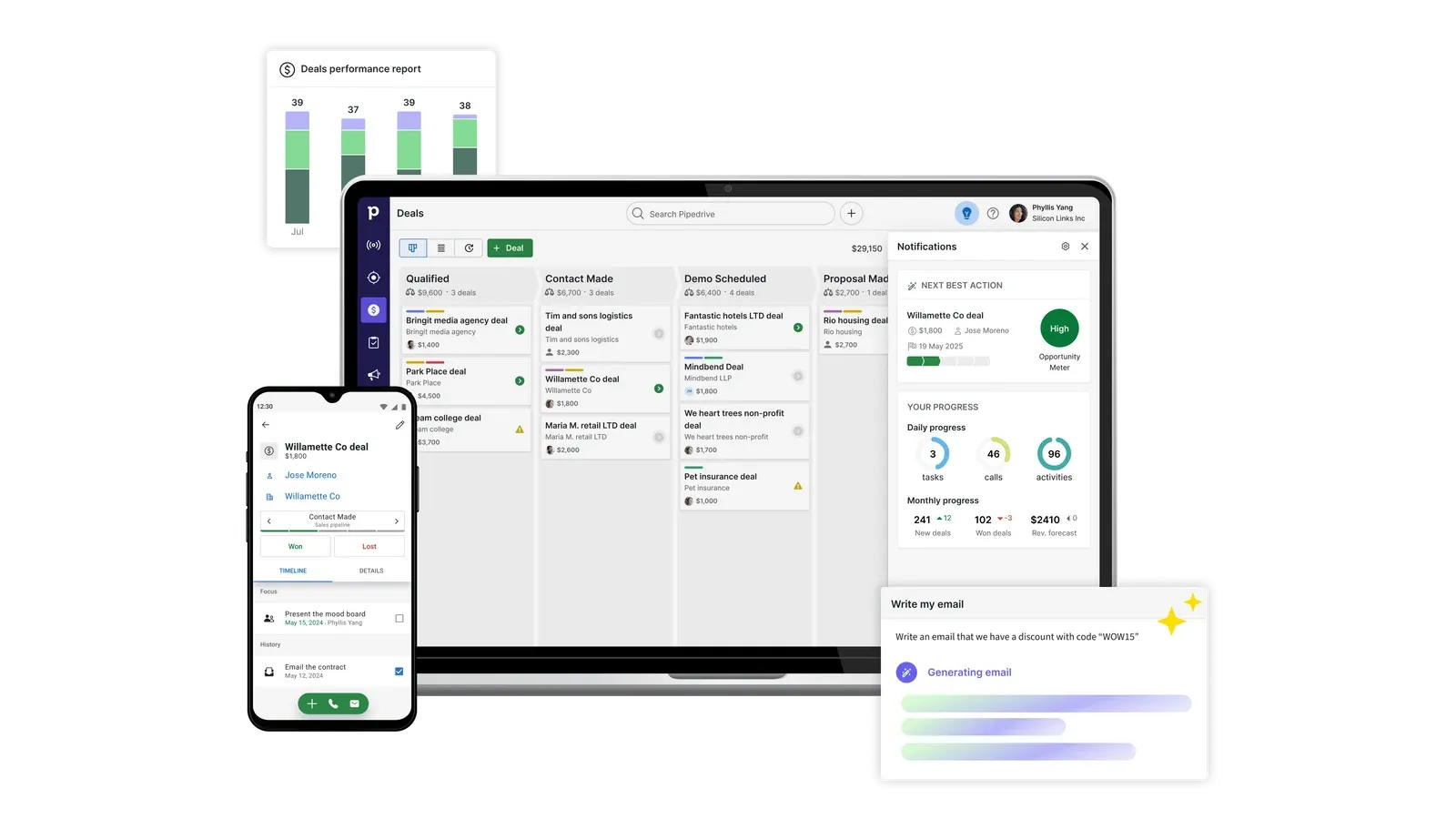
Pipedrive product interface

The picks

  1. Our pick

    Pipedrive

    Best for Agencies that need a clear new-business pipeline, disciplined follow-up, and usable forecasts

    Pipedrive is the cleanest fit when the CRM must make business development visible without becoming a second operations platform.

    9.4/10WireRanked score
    View plans
  2. Also great

    monday CRM

    Best for Agencies already using monday.com or wanting configurable pre-sale and post-sale boards

    monday CRM is the strongest bridge from opportunity tracking into handoff and delivery, but seat blocks and automation limits need pricin…

    9.1/10WireRanked score
    Full reviewFull review
  3. Also great

    folk

    Best for Small agencies that win work through referrals, partnerships, events, and personalized outreach

    folk is the most natural relationship-first option here, especially for teams collecting contacts from LinkedIn and shared networks.

    8.8/10WireRanked score
    Full reviewFull review

Pipedrive is the best CRM for agencies that need a focused new-business pipeline, consistent follow-up, and a forecast the team can trust. monday CRM is the better choice when sales must connect directly to delivery, while folk is the lightweight pick for relationship-led agencies.

We ranked these tools for the actual agency operating problem: turning referrals, inbound inquiries, partnerships, and outbound prospects into signed work without losing context at the handoff. This is official-source desk research, not hands-on product testing.

The shortlist

Our ranked picks

Six CRMs ranked for agencies based on pipeline clarity, relationship context, communication, automation, forecasting, sales-to-delivery handoff, verified pricing, limits, and operating complexity.

Pricing checked October 15, 2026
1
Our pick

Pipedrive

Pipedrive is the cleanest fit when the CRM must make business development visible without becoming a second operations platform.

Full review ↓
Best for
Agencies that need a clear new-business pipeline, disciplined follow-up, and usable forecasts
9.4/10WireRanked score
View plans
2
Also great

monday CRM

monday CRM is the strongest bridge from opportunity tracking into handoff and delivery, but seat blocks and automation limits need pricing attention.

Full review ↓
Best for
Agencies already using monday.com or wanting configurable pre-sale and post-sale boards
9.1/10WireRanked score
See current pricing
3
Also great

folk

folk is the most natural relationship-first option here, especially for teams collecting contacts from LinkedIn and shared networks.

Full review ↓
Best for
Small agencies that win work through referrals, partnerships, events, and personalized outreach
8.8/10WireRanked score
View plans
4
Best for outbound-heavy agency sales

Close

Close is the specialist when outbound activity is the operating model, though meaningful workflow automation starts at an expensive tier.

Full review ↓
Best for
Agencies whose growth team spends the day calling, emailing, texting, and sequencing prospects

8.5/10WireRanked score
See current pricing
5
Best for integrated marketing and sales

HubSpot Smart CRM

HubSpot has the broadest client-acquisition platform here, but the paid configuration is harder to price than a focused sales CRM.

Full review ↓
Best for
Agencies needing forms, marketing, sales, service and content data around one customer record
8.2/10WireRanked score
Visit product
6
Best for a custom agency data model

Attio

Attio is the flexible-model pick, not the default recommendation: it rewards teams willing to design their own operating structure.

Full review ↓
Best for
Technical agencies that want flexible objects, lists, workflows, reporting and relationship data
7.9/10WireRanked score
View plans

At a glance

Compare the top picks

Swipe to compare all columns

RankLogoProductWireRankBest forStarting priceStandoutAction
#2monday CRM9.1 / 10Agencies already using monday.com or wanting configurable pre-sale and post-sale boards$12/seat/month billed annually for BasicLast verified October 15, 2026Best for connecting sales and delivery workflowsSee current pricing
#3folk8.8 / 10Small agencies that win work through referrals, partnerships, events, and personalized outreach$24/member/month billed annually for StandardLast verified October 15, 2026Best lightweight relationship CRMView plans
#4Close8.5 / 10Agencies whose growth team spends the day calling, emailing, texting, and sequencing prospectsSolo $9/user/month; Essentials $35 (billed annually)Last verified October 15, 2026Best for outbound-heavy agency salesSee current pricing
#5HubSpot Smart CRM8.2 / 10Agencies needing forms, marketing, sales, service and content data around one customer record$0 free CRMLast verified October 15, 2026Best for integrated marketing and salesVisit product
#6Attio7.9 / 10Technical agencies that want flexible objects, lists, workflows, reporting and relationship data$0 for up to 3 seatsLast verified October 15, 2026Best for a custom agency data modelView plans
#2

Best for connecting sales and delivery workflows

monday CRM

Best for
Agencies already using monday.com or wanting configurable pre-sale and post-sale boards
Starting price
$12/seat/month billed annually for BasicLast verified October 15, 2026
Our rating
9.1/10WireRanked score
See current pricing
#3

Best lightweight relationship CRM

folk

Best for
Small agencies that win work through referrals, partnerships, events, and personalized outreach
Starting price
$24/member/month billed annually for StandardLast verified October 15, 2026
Our rating
8.8/10WireRanked score
View plans
#4

Best for outbound-heavy agency sales

Close

Best for
Agencies whose growth team spends the day calling, emailing, texting, and sequencing prospects
Starting price
Solo $9/user/month; Essentials $35 (billed annually)Last verified October 15, 2026
Our rating
8.5/10WireRanked score
See current pricing
#5

Best for integrated marketing and sales

HubSpot Smart CRM

Best for
Agencies needing forms, marketing, sales, service and content data around one customer record
Starting price
$0 free CRMLast verified October 15, 2026
Our rating
8.2/10WireRanked score
Visit product
#6

Best for a custom agency data model

Attio

Best for
Technical agencies that want flexible objects, lists, workflows, reporting and relationship data
Starting price
$0 for up to 3 seatsLast verified October 15, 2026
Our rating
7.9/10WireRanked score
View plans

Choose This CRM If...Choose an agency CRM by operating model

If you need agencies already using monday.com or wanting configurable pre-sale and post-sale boards

monday CRM is the strongest bridge from opportunity tracking into handoff and delivery, but seat blocks and automation limits need pricing attention.

See current pricing
If you need small agencies that win work through referrals, partnerships, events, and personalized outreach

folk is the most natural relationship-first option here, especially for teams collecting contacts from LinkedIn and shared networks.

View plans
If you need agencies whose growth team spends the day calling, emailing, texting, and sequencing prospects

Close is the specialist when outbound activity is the operating model, though meaningful workflow automation starts at an expensive tier.

See current pricing
If you need agencies needing forms, marketing, sales, service and content data around one customer record

HubSpot has the broadest client-acquisition platform here, but the paid configuration is harder to price than a focused sales CRM.

Visit product
If you need technical agencies that want flexible objects, lists, workflows, reporting and relationship data

Attio is the flexible-model pick, not the default recommendation: it rewards teams willing to design their own operating structure.

View plans
01

Best overall for sales-focused agencies

Pipedrive

Pipedrive is the cleanest fit when the CRM must make business development visible without becoming a second operations platform.

9.4/10WireRanked score
View plans
Best forAgencies that need a clear new-business pipeline, disciplined follow-up, and usable forecastsStarting price$14/seat/month billed annually for LiteLast verified October 15, 2026Editorial callBest overall for sales-focused agencies

1. Pipedrive — best overall for sales-focused agencies

Pipedrive ranks first because most agencies need a dependable new-business system before they need a highly configurable customer platform. Its deal-and-activity model answers the questions that matter in a pipeline meeting: which opportunity is moving, who owns the next step, how long it has sat in a stage, and what revenue may close.

Lite covers contacts, leads, calendars, pipelines, activities, imports, exports, and basic reporting. Growth is the more realistic operating tier because it adds full email synchronization and tracking, automations, nurturing sequences, subscriptions, forecasts, and meeting scheduling. Premium adds routing, scoring, enrichment, contracts, signatures, formula fields, and tighter controls. That ladder lets an agency start with a simple pitch pipeline and add governance as business development becomes a dedicated function.

Pipedrive can hand a won deal to another system, and Projects is available as an add-on or in higher plans, but it is not a full agency resource-planning platform. Best for: agencies that want sales discipline and forecast visibility. Skip this if: one configurable workspace must run sales, delivery, capacity, and client collaboration.

Key tradeoff: Project delivery is not the core product

Starting price
$14/seat/month billed annually for Lite · SourceChecked October 15, 2026
Key plan limit
Growth is the practical baseline for full email sync, automations, sequences and forecasting. · SourceChecked October 15, 2026
02

Best for connecting sales and delivery workflows

monday CRM

monday CRM is the strongest bridge from opportunity tracking into handoff and delivery, but seat blocks and automation limits need pricing attention.

9.1/10WireRanked score
See current pricing
Best forAgencies already using monday.com or wanting configurable pre-sale and post-sale boardsStarting price$12/seat/month billed annually for BasicLast verified October 15, 2026Editorial callBest for connecting sales and delivery workflows

2. monday CRM — best for connecting sales and delivery workflows

monday CRM ranks second because agencies often need the handoff from sale to delivery to be as visible as the sale itself. Boards, columns, automations, dashboards, and connected monday products can model qualification, proposals, onboarding, production, and account work.

Basic starts at $12 per seat per month billed annually, but its 1,000 active-contact-and-deal limit, five columns per board, and limited dashboard make it a narrow entry point. Standard is $17 annually and expands the record limit to 10,000, adds email and AI capabilities, and includes 250 monthly custom automations. Pro is $28 annually, raises the active-record limit to 100,000, and expands dashboards, columns, quotes, invoices, and automations substantially. Plans start from three seats and annual billing is prepaid.

The buying risk is turning flexibility into inconsistency. Someone must define boards, ownership, required fields, handoff rules, and which work belongs in CRM versus delivery. Best for: agencies already invested in monday.com or deliberately unifying revenue and delivery workflows. Skip this if: the team wants a prescriptive sales pipeline with minimal configuration.

Key tradeoff: Minimum seat bundles can inflate small-team cost

Starting price
$12/seat/month billed annually for Basic · SourceChecked October 15, 2026
Key plan limit
Standard is $17 and Pro $28 per seat/month annually. Basic has 1,000 active contacts and deals; Standard 10,000; Pro 100,000. · SourceChecked October 15, 2026
03

Best lightweight relationship CRM

folk

folk is the most natural relationship-first option here, especially for teams collecting contacts from LinkedIn and shared networks.

8.8/10WireRanked score
View plans
Best forSmall agencies that win work through referrals, partnerships, events, and personalized outreachStarting price$24/member/month billed annually for StandardLast verified October 15, 2026Editorial callBest lightweight relationship CRM

3. folk — best lightweight relationship CRM

folk is the best lightweight option for agencies whose pipeline begins with relationships rather than form fills. Shared groups, pipelines, contact enrichment, the LinkedIn extension, and synchronized email, calendar, and WhatsApp activity make it easier to turn referrals, events, partner conversations, and founder networks into an organized follow-up process without imposing a heavyweight enterprise model.

Standard costs $24 per member per month billed annually or $30 monthly. It includes unlimited contacts, pipeline management, email campaigns, enrichment, AI assistants, AI fields, the LinkedIn extension, communication sync, and thousands of integrations. Premium costs $48 annually or $60 monthly and is important for a mature agency because it adds custom objects and deals, sequences, workspace roles, dashboards, API access, full interaction history, and higher usage allowances.

folk is less convincing when an agency needs complex territories, formal forecasts, deep service workflows, or delivery planning. Its credit limits for enrichment, messages, synchronization, and AI fields also need to be modeled. Best for: referral- and network-led agencies that prioritize usable relationship context. Skip this if: sales operations require enterprise controls or the CRM must manage project capacity.

Key tradeoff: Premium is required for deals, sequences and dashboards

Starting price
$24/member/month billed annually for Standard · SourceChecked October 15, 2026
Key plan limit
Premium is $48/member/month annually and adds deals, sequences, dashboards, API access and advanced roles. · SourceChecked October 15, 2026
04

Best for outbound-heavy agency sales

Close

Close is the specialist when outbound activity is the operating model, though meaningful workflow automation starts at an expensive tier.

8.5/10WireRanked score
See current pricing
Best forAgencies whose growth team spends the day calling, emailing, texting, and sequencing prospectsStarting priceSolo $9/user/month; Essentials $35 (billed annually)Last verified October 15, 2026Editorial callBest for outbound-heavy agency sales

4. Close — best for outbound-heavy agency sales

Close fits agencies that manufacture pipeline through outbound prospecting. Calls, email, SMS, tasks, forms, an inbox, contacts, leads, opportunities, and pipeline context live together, so a growth team can work a list without switching among a CRM, dialer, and sequencing tool.

Close starts with Solo at $9 per user per month billed annually ($19 monthly), limited to one user. Essentials costs $35 per user per month billed annually or $49 monthly and supports unlimited contacts and leads, collaboration, calling, email, SMS, forms, tasks, and pipeline visibility. Growth jumps to $99 annually or $109 monthly but adds the workflows, power dialer, custom activities, bulk email, and AI workflow actions that make Close distinctive. Scale costs $139 annually and adds predictive dialing, lead visibility, advanced controls, and coaching.

Subscription price is incomplete because telephony, SMS, numbers, Call Assistant, and additional AI usage can add cost. Close also does little for delivery after the contract is signed. Best for: an agency with a dedicated outbound sales motion and enough volume to justify Growth. Skip this if: referrals dominate, calls are occasional, or the CRM must coordinate client work.

Key tradeoff: Automation requires the $99 Growth tier

Starting price
Solo $9/user/month; Essentials $35 (billed annually) · SourceChecked October 15, 2026
Key plan limit
Growth is $99/user/month annually and is required for workflows and power dialing. · SourceChecked October 15, 2026
05

Best for integrated marketing and sales

HubSpot Smart CRM

HubSpot has the broadest client-acquisition platform here, but the paid configuration is harder to price than a focused sales CRM.

8.2/10WireRanked score
Visit product
Best forAgencies needing forms, marketing, sales, service and content data around one customer recordStarting price$0 free CRMLast verified October 15, 2026Editorial callBest for integrated marketing and sales

5. HubSpot Smart CRM — best for integrated marketing and sales

HubSpot is strongest when an agency wants one customer record to connect demand generation, sales follow-up, service, content, and lifecycle reporting. Forms and campaign responses can flow into the CRM; sales and account teams can work from the same history; and the free CRM provides a real starting point. This is particularly relevant to agencies that also use HubSpot internally or deliver HubSpot-related services to clients.

The tradeoff is commercial clarity. The official CRM page confirms a free product and a path into paid Hubs, but the dynamic pricing experience did not provide a single dependable all-in figure for the configuration an agency might need. Seats, marketing contacts, automation, reporting, onboarding, multiple Hubs, and HubSpot Credits can all affect total cost. Price the actual package against a documented workflow rather than anchoring on free entry.

HubSpot ranks below focused tools because many agencies only need pipeline and follow-up, not an integrated customer platform. Best for: agencies whose marketing, sales, and service data genuinely need to share one system. Skip this if: a transparent per-seat sales tool solves the problem and nobody will own a broader platform.

Key tradeoff: Premium total cost requires configuration

Starting price
$0 free CRM · SourceChecked October 15, 2026
Key plan limit
Free CRM costs $0; paid Hubs are priced separately by product and seat, so price the full configuration before buying. · SourceChecked October 15, 2026
06

Best for a custom agency data model

Attio

Attio is the flexible-model pick, not the default recommendation: it rewards teams willing to design their own operating structure.

7.9/10WireRanked score
View plans
Best forTechnical agencies that want flexible objects, lists, workflows, reporting and relationship dataStarting price$0 for up to 3 seatsLast verified October 15, 2026Editorial callBest for a custom agency data model

6. Attio — best for a custom agency data model

Attio is the most flexible data-model option in this ranking. An agency can represent companies, people, opportunities, partners, projects, retainers, and other relationships with custom objects and lists instead of squeezing every process into a conventional lead-and-deal hierarchy. Real-time contact sync and automatic enrichment reduce some of the record maintenance that custom models usually create.

The free plan supports up to three seats. Plus costs $35 per user per month billed annually or $44 monthly and supports up to ten seats, private lists, and enhanced email sending. Pro costs $79 annually or $99 monthly and adds call intelligence, sequences, permission controls, and advanced reporting. Enterprise adds unlimited objects and teams plus security and administration controls at a custom price.

Flexibility has an operating cost: the agency must decide what objects mean, who owns data quality, and which workflows deserve automation. Best for: technical teams with unusual relationship structures. Skip this if: users need a ready-made sales process on day one.

Key tradeoff: Requires more process design than a prescriptive CRM

Starting price
$0 for up to 3 seats · SourceChecked October 15, 2026
Key plan limit
Plus is $35/user/month annually; Pro is $79 and adds call intelligence, sequences, permission controls and advanced reporting. · SourceChecked October 15, 2026

How to choose CRM software for an agency

Buying criteria and research

Map the path from first touch to signed work

Document how referrals, forms, events, partners, prospecting, and existing clients create opportunities. Define qualification, discovery, proposal, negotiation, verbal commitment, won, and lost in language the whole team understands. Each stage needs an owner, exit evidence, and next-action rule.

Design the sales-to-delivery handoff

A won opportunity should create a named delivery owner, scope reference, commercial value, start expectation, client contacts, and required kickoff actions. Decide whether that information moves through an integration, a connected board, or a controlled manual process. Do not force project tasks into the CRM merely to avoid integration work.

Price the usable tier and full team

Count founders, business-development staff, account leaders, and delivery managers who must edit records. Then add minimum seat bundles, annual prepayment, automations, email, phone and SMS usage, enrichment, AI credits, forms, marketing contacts, onboarding, documents, and delivery software. The cheapest headline plan often omits the workflow that justified buying a CRM.

Protect relationship context without collecting noise

Agencies need source, relationship owner, last meaningful interaction, service interest, decision process, proposal status, next action, and loss reason. They rarely need dozens of mandatory fields at first contact. Make required fields stage-specific, merge duplicates, define ownership changes, and record why a deal advances so the database supports action rather than surveillance.

Run a representative acceptance test

Use real-shaped sample data to capture inbound and referred leads, assign ownership, synchronize communication, schedule follow-up, generate a proposal, forecast the month, hand a won deal to delivery, restrict sensitive records, and export everything. We did not perform this test and make no hands-on claim; the agency should validate its own workflow before migration.

How we chose the best CRM for agencies

We reviewed official vendor pricing and product pages on July 25–27, 2026 (prices, plans and limits rechecked October 15, 2026). We weighted new-business pipeline clarity, relationship context, communication, automation, forecasting, handoff support, configuration burden, limits, and total buying complexity.

Payout did not influence rank. Attio is included because it is a credible fit for custom agency data models. HubSpot’s paid pricing depends on the configuration, so we do not quote an all-in figure.

Final recommendation

Final recommendation

Choose Pipedrive when the agency needs a clear, adoptable new-business pipeline. Choose monday CRM when sales and delivery must share a configurable work system, folk for relationship-led growth, Close for high-volume outbound, HubSpot for an integrated customer platform, and Attio for a custom data model.

Top pick: Pipedrive for agencies that need a clear new-business pipeline, disciplined follow-up, and usable forecasts.

Validate the exact paid tier, team size, communication usage, integrations, export, and won-deal handoff with representative data before migrating the live pipeline.

View plans

The shortlist

Our ranked picks

Six CRMs ranked for agencies based on pipeline clarity, relationship context, communication, automation, forecasting, sales-to-delivery handoff, verified pricing, limits, and operating complexity.

Pricing checked October 15, 2026

1
Our pick

Pipedrive

Pipedrive is the cleanest fit when the CRM must make business development visible without becoming a second operations platform.

Full review ↓
Best for
Agencies that need a clear new-business pipeline, disciplined follow-up, and usable forecasts
9.4/10WireRanked score
View plans
2
Also great

monday CRM

monday CRM is the strongest bridge from opportunity tracking into handoff and delivery, but seat blocks and automation limits need pricing attention.

Full review ↓
Best for
Agencies already using monday.com or wanting configurable pre-sale and post-sale boards
9.1/10WireRanked score
See current pricing
3
Also great

folk

folk is the most natural relationship-first option here, especially for teams collecting contacts from LinkedIn and shared networks.

Full review ↓
Best for
Small agencies that win work through referrals, partnerships, events, and personalized outreach
8.8/10WireRanked score
View plans
4
Best for outbound-heavy agency sales

Close

Close is the specialist when outbound activity is the operating model, though meaningful workflow automation starts at an expensive tier.

Full review ↓
Best for
Agencies whose growth team spends the day calling, emailing, texting, and sequencing prospects
8.5/10WireRanked score
See current pricing
5
Best for integrated marketing and sales

HubSpot Smart CRM

HubSpot has the broadest client-acquisition platform here, but the paid configuration is harder to price than a focused sales CRM.

Full review ↓
Best for
Agencies needing forms, marketing, sales, service and content data around one customer record
8.2/10WireRanked score
Visit product
6
Best for a custom agency data model

Attio

Attio is the flexible-model pick, not the default recommendation: it rewards teams willing to design their own operating structure.

Full review ↓
Best for
Technical agencies that want flexible objects, lists, workflows, reporting and relationship data
7.9/10WireRanked score
View plans

At a glance

Compare the top picks

Swipe to compare all columns

RankLogoProductWireRankBest forStarting priceStandoutAction
#2monday CRM9.1 / 10Agencies already using monday.com or wanting configurable pre-sale and post-sale boards$12/seat/month billed annually for BasicLast verified October 15, 2026Best for connecting sales and delivery workflowsSee current pricing
#3folk8.8 / 10Small agencies that win work through referrals, partnerships, events, and personalized outreach$24/member/month billed annually for StandardLast verified October 15, 2026Best lightweight relationship CRMView plans
#4Close8.5 / 10Agencies whose growth team spends the day calling, emailing, texting, and sequencing prospectsSolo $9/user/month; Essentials $35 (billed annually)Last verified October 15, 2026Best for outbound-heavy agency salesSee current pricing
#5HubSpot Smart CRM8.2 / 10Agencies needing forms, marketing, sales, service and content data around one customer record$0 free CRMLast verified October 15, 2026Best for integrated marketing and salesVisit product
#6Attio7.9 / 10Technical agencies that want flexible objects, lists, workflows, reporting and relationship data$0 for up to 3 seatsLast verified October 15, 2026Best for a custom agency data modelView plans
#2

Best for connecting sales and delivery workflows

monday CRM

Best for
Agencies already using monday.com or wanting configurable pre-sale and post-sale boards
Starting price
$12/seat/month billed annually for BasicLast verified October 15, 2026
Our rating
9.1/10WireRanked score
See current pricing
#3

Best lightweight relationship CRM

folk

Best for
Small agencies that win work through referrals, partnerships, events, and personalized outreach
Starting price
$24/member/month billed annually for StandardLast verified October 15, 2026
Our rating
8.8/10WireRanked score
View plans
#4

Best for outbound-heavy agency sales

Close

Best for
Agencies whose growth team spends the day calling, emailing, texting, and sequencing prospects
Starting price
Solo $9/user/month; Essentials $35 (billed annually)Last verified October 15, 2026
Our rating
8.5/10WireRanked score
See current pricing
#5

Best for integrated marketing and sales

HubSpot Smart CRM

Best for
Agencies needing forms, marketing, sales, service and content data around one customer record
Starting price
$0 free CRMLast verified October 15, 2026
Our rating
8.2/10WireRanked score
Visit product
#6

Best for a custom agency data model

Attio

Best for
Technical agencies that want flexible objects, lists, workflows, reporting and relationship data
Starting price
$0 for up to 3 seatsLast verified October 15, 2026
Our rating
7.9/10WireRanked score
View plans

Choose This CRM If...Choose an agency CRM by operating model

If you need agencies already using monday.com or wanting configurable pre-sale and post-sale boards

monday CRM is the strongest bridge from opportunity tracking into handoff and delivery, but seat blocks and automation limits need pricing attention.

See current pricing
If you need small agencies that win work through referrals, partnerships, events, and personalized outreach

folk is the most natural relationship-first option here, especially for teams collecting contacts from LinkedIn and shared networks.

View plans
If you need agencies whose growth team spends the day calling, emailing, texting, and sequencing prospects

Close is the specialist when outbound activity is the operating model, though meaningful workflow automation starts at an expensive tier.

See current pricing
If you need agencies needing forms, marketing, sales, service and content data around one customer record

HubSpot has the broadest client-acquisition platform here, but the paid configuration is harder to price than a focused sales CRM.

Visit product
If you need technical agencies that want flexible objects, lists, workflows, reporting and relationship data

Attio is the flexible-model pick, not the default recommendation: it rewards teams willing to design their own operating structure.

View plans
#1

Pipedrive

Best overall for sales-focused agencies

9.4/10WireRanked score

Best for Agencies that need a clear new-business pipeline, disciplined follow-up, and usable forecasts

View plans

Our take

1. Pipedrive — best overall for sales-focused agencies

Pipedrive ranks first because most agencies need a dependable new-business system before they need a highly configurable customer platform. Its deal-and-activity model answers the questions that matter in a pipeline meeting: which opportunity is moving, who owns the next step, how long it has sat in a stage, and what revenue may close.

Lite covers contacts, leads, calendars, pipelines, activities, imports, exports, and basic reporting. Growth is the more realistic operating tier because it adds full email synchronization and tracking, automations, nurturing sequences, subscriptions, forecasts, and meeting scheduling. Premium adds routing, scoring, enrichment, contracts, signatures, formula fields, and tighter controls. That ladder lets an agency start with a simple pitch pipeline and add governance as business development becomes a dedicated function.

Pipedrive can hand a won deal to another system, and Projects is available as an add-on or in higher plans, but it is not a full agency resource-planning platform. Best for: agencies that want sales discipline and forecast visibility. Skip this if: one configurable workspace must run sales, delivery, capacity, and client collaboration.

Starting price $14/seat/month billed annually for Lite

Key tradeoff: Project delivery is not the core product

#2

monday CRM

Best for connecting sales and delivery workflows

9.1/10WireRanked score

Best for Agencies already using monday.com or wanting configurable pre-sale and post-sale boards

See current pricing

Our take

2. monday CRM — best for connecting sales and delivery workflows

monday CRM ranks second because agencies often need the handoff from sale to delivery to be as visible as the sale itself. Boards, columns, automations, dashboards, and connected monday products can model qualification, proposals, onboarding, production, and account work.

Basic starts at $12 per seat per month billed annually, but its 1,000 active-contact-and-deal limit, five columns per board, and limited dashboard make it a narrow entry point. Standard is $17 annually and expands the record limit to 10,000, adds email and AI capabilities, and includes 250 monthly custom automations. Pro is $28 annually, raises the active-record limit to 100,000, and expands dashboards, columns, quotes, invoices, and automations substantially. Plans start from three seats and annual billing is prepaid.

The buying risk is turning flexibility into inconsistency. Someone must define boards, ownership, required fields, handoff rules, and which work belongs in CRM versus delivery. Best for: agencies already invested in monday.com or deliberately unifying revenue and delivery workflows. Skip this if: the team wants a prescriptive sales pipeline with minimal configuration.

Starting price $12/seat/month billed annually for Basic

Key tradeoff: Minimum seat bundles can inflate small-team cost

#3

folk

Best lightweight relationship CRM

8.8/10WireRanked score

Best for Small agencies that win work through referrals, partnerships, events, and personalized outreach

View plans

Our take

3. folk — best lightweight relationship CRM

folk is the best lightweight option for agencies whose pipeline begins with relationships rather than form fills. Shared groups, pipelines, contact enrichment, the LinkedIn extension, and synchronized email, calendar, and WhatsApp activity make it easier to turn referrals, events, partner conversations, and founder networks into an organized follow-up process without imposing a heavyweight enterprise model.

Standard costs $24 per member per month billed annually or $30 monthly. It includes unlimited contacts, pipeline management, email campaigns, enrichment, AI assistants, AI fields, the LinkedIn extension, communication sync, and thousands of integrations. Premium costs $48 annually or $60 monthly and is important for a mature agency because it adds custom objects and deals, sequences, workspace roles, dashboards, API access, full interaction history, and higher usage allowances.

folk is less convincing when an agency needs complex territories, formal forecasts, deep service workflows, or delivery planning. Its credit limits for enrichment, messages, synchronization, and AI fields also need to be modeled. Best for: referral- and network-led agencies that prioritize usable relationship context. Skip this if: sales operations require enterprise controls or the CRM must manage project capacity.

Starting price $24/member/month billed annually for Standard

Key tradeoff: Premium is required for deals, sequences and dashboards

#4

Close

Best for outbound-heavy agency sales

8.5/10WireRanked score

Best for Agencies whose growth team spends the day calling, emailing, texting, and sequencing prospects

See current pricing

Our take

4. Close — best for outbound-heavy agency sales

Close fits agencies that manufacture pipeline through outbound prospecting. Calls, email, SMS, tasks, forms, an inbox, contacts, leads, opportunities, and pipeline context live together, so a growth team can work a list without switching among a CRM, dialer, and sequencing tool.

Close starts with Solo at $9 per user per month billed annually ($19 monthly), limited to one user. Essentials costs $35 per user per month billed annually or $49 monthly and supports unlimited contacts and leads, collaboration, calling, email, SMS, forms, tasks, and pipeline visibility. Growth jumps to $99 annually or $109 monthly but adds the workflows, power dialer, custom activities, bulk email, and AI workflow actions that make Close distinctive. Scale costs $139 annually and adds predictive dialing, lead visibility, advanced controls, and coaching.

Subscription price is incomplete because telephony, SMS, numbers, Call Assistant, and additional AI usage can add cost. Close also does little for delivery after the contract is signed. Best for: an agency with a dedicated outbound sales motion and enough volume to justify Growth. Skip this if: referrals dominate, calls are occasional, or the CRM must coordinate client work.

Starting price Solo $9/user/month; Essentials $35 (billed annually)

Key tradeoff: Automation requires the $99 Growth tier

#5

HubSpot Smart CRM

Best for integrated marketing and sales

8.2/10WireRanked score

Best for Agencies needing forms, marketing, sales, service and content data around one customer record

Visit product

Our take

5. HubSpot Smart CRM — best for integrated marketing and sales

HubSpot is strongest when an agency wants one customer record to connect demand generation, sales follow-up, service, content, and lifecycle reporting. Forms and campaign responses can flow into the CRM; sales and account teams can work from the same history; and the free CRM provides a real starting point. This is particularly relevant to agencies that also use HubSpot internally or deliver HubSpot-related services to clients.

The tradeoff is commercial clarity. The official CRM page confirms a free product and a path into paid Hubs, but the dynamic pricing experience did not provide a single dependable all-in figure for the configuration an agency might need. Seats, marketing contacts, automation, reporting, onboarding, multiple Hubs, and HubSpot Credits can all affect total cost. Price the actual package against a documented workflow rather than anchoring on free entry.

HubSpot ranks below focused tools because many agencies only need pipeline and follow-up, not an integrated customer platform. Best for: agencies whose marketing, sales, and service data genuinely need to share one system. Skip this if: a transparent per-seat sales tool solves the problem and nobody will own a broader platform.

Starting price $0 free CRM

Key tradeoff: Premium total cost requires configuration

#6

Attio

Best for a custom agency data model

7.9/10WireRanked score

Best for Technical agencies that want flexible objects, lists, workflows, reporting and relationship data

View plans

Our take

6. Attio — best for a custom agency data model

Attio is the most flexible data-model option in this ranking. An agency can represent companies, people, opportunities, partners, projects, retainers, and other relationships with custom objects and lists instead of squeezing every process into a conventional lead-and-deal hierarchy. Real-time contact sync and automatic enrichment reduce some of the record maintenance that custom models usually create.

The free plan supports up to three seats. Plus costs $35 per user per month billed annually or $44 monthly and supports up to ten seats, private lists, and enhanced email sending. Pro costs $79 annually or $99 monthly and adds call intelligence, sequences, permission controls, and advanced reporting. Enterprise adds unlimited objects and teams plus security and administration controls at a custom price.

Flexibility has an operating cost: the agency must decide what objects mean, who owns data quality, and which workflows deserve automation. Best for: technical teams with unusual relationship structures. Skip this if: users need a ready-made sales process on day one.

Starting price $0 for up to 3 seats

Key tradeoff: Requires more process design than a prescriptive CRM

How to choose CRM software for an agency

Buying criteria and research

Map the path from first touch to signed work

Document how referrals, forms, events, partners, prospecting, and existing clients create opportunities. Define qualification, discovery, proposal, negotiation, verbal commitment, won, and lost in language the whole team understands. Each stage needs an owner, exit evidence, and next-action rule.

Design the sales-to-delivery handoff

A won opportunity should create a named delivery owner, scope reference, commercial value, start expectation, client contacts, and required kickoff actions. Decide whether that information moves through an integration, a connected board, or a controlled manual process. Do not force project tasks into the CRM merely to avoid integration work.

Price the usable tier and full team

Count founders, business-development staff, account leaders, and delivery managers who must edit records. Then add minimum seat bundles, annual prepayment, automations, email, phone and SMS usage, enrichment, AI credits, forms, marketing contacts, onboarding, documents, and delivery software. The cheapest headline plan often omits the workflow that justified buying a CRM.

Protect relationship context without collecting noise

Agencies need source, relationship owner, last meaningful interaction, service interest, decision process, proposal status, next action, and loss reason. They rarely need dozens of mandatory fields at first contact. Make required fields stage-specific, merge duplicates, define ownership changes, and record why a deal advances so the database supports action rather than surveillance.

Run a representative acceptance test

Use real-shaped sample data to capture inbound and referred leads, assign ownership, synchronize communication, schedule follow-up, generate a proposal, forecast the month, hand a won deal to delivery, restrict sensitive records, and export everything. We did not perform this test and make no hands-on claim; the agency should validate its own workflow before migration.

Frequently asked questions

What is the best CRM for an agency?

Pipedrive is our top overall pick for a sales-focused agency because it keeps opportunities, next actions, email follow-up, automation, and forecasts coherent without requiring a large operations team. monday CRM is better when sales must connect directly to delivery boards. folk is the stronger lightweight choice for referral- and relationship-led business development.

Should an agency use a CRM or project management software?

Use a CRM to manage companies, contacts, opportunities, communication history, proposals, follow-up, and forecasts. Use project-management software to plan deliverables, assignments, deadlines, approvals, and capacity after the sale. Some agencies connect separate systems; others use monday.com for both. Define the handoff explicitly so a won deal cannot disappear between tools.

Is HubSpot a good CRM for agencies?

Yes when marketing, sales, service, and account data need to share one customer record, or when the agency already delivers HubSpot work. A sales-only agency may get faster adoption and clearer pricing from Pipedrive. Model the exact HubSpot seats, contacts, Hubs, automation, reporting, onboarding, and credits before treating the free CRM as the long-term cost.

What CRM is best for a small creative agency?

folk is a strong fit for a small creative agency that wins through relationships, referrals, events, and personalized outreach. Pipedrive is better when the agency needs a formal opportunity pipeline and forecast. monday CRM is stronger when briefs and delivery boards must connect to the sale. The best choice depends on the handoff, not the agency label.

How much does agency CRM software cost?

The verified entry points here range from free to $24 per user per month on annual billing, but entry price is rarely the usable price. Include minimum seat bundles, automation tiers, email or calling usage, enrichment and AI credits, onboarding, marketing contacts, and delivery tools. Price a representative team and workflow for twelve months.

What should an agency track in its CRM?

Track account and contact ownership, opportunity source, service line, estimated value, probability, stage, next action, decision process, proposal status, expected close date, loss reason, and the post-sale owner. Keep delivery details in the delivery system unless the CRM is deliberately designed to hold them. Require only fields used in follow-up, forecasting, or handoff.

How should an agency test a CRM before buying?

Import representative contacts and opportunities, connect email and calendar, capture an inbound lead, run a referral follow-up, build a proposal stage, change ownership, forecast the month, hand a won deal to delivery, and export all important records. This article is official-source desk research, not hands-on testing; the agency should perform that acceptance test itself.

Frequently asked questions

What is the best CRM for an agency?

Pipedrive is our top overall pick for a sales-focused agency because it keeps opportunities, next actions, email follow-up, automation, and forecasts coherent without requiring a large operations team. monday CRM is better when sales must connect directly to delivery boards. folk is the stronger lightweight choice for referral- and relationship-led business development.

Should an agency use a CRM or project management software?

Use a CRM to manage companies, contacts, opportunities, communication history, proposals, follow-up, and forecasts. Use project-management software to plan deliverables, assignments, deadlines, approvals, and capacity after the sale. Some agencies connect separate systems; others use monday.com for both. Define the handoff explicitly so a won deal cannot disappear between tools.

Is HubSpot a good CRM for agencies?

Yes when marketing, sales, service, and account data need to share one customer record, or when the agency already delivers HubSpot work. A sales-only agency may get faster adoption and clearer pricing from Pipedrive. Model the exact HubSpot seats, contacts, Hubs, automation, reporting, onboarding, and credits before treating the free CRM as the long-term cost.

What CRM is best for a small creative agency?

folk is a strong fit for a small creative agency that wins through relationships, referrals, events, and personalized outreach. Pipedrive is better when the agency needs a formal opportunity pipeline and forecast. monday CRM is stronger when briefs and delivery boards must connect to the sale. The best choice depends on the handoff, not the agency label.

How much does agency CRM software cost?

The verified entry points here range from free to $24 per user per month on annual billing, but entry price is rarely the usable price. Include minimum seat bundles, automation tiers, email or calling usage, enrichment and AI credits, onboarding, marketing contacts, and delivery tools. Price a representative team and workflow for twelve months.

What should an agency track in its CRM?

Track account and contact ownership, opportunity source, service line, estimated value, probability, stage, next action, decision process, proposal status, expected close date, loss reason, and the post-sale owner. Keep delivery details in the delivery system unless the CRM is deliberately designed to hold them. Require only fields used in follow-up, forecasting, or handoff.

How should an agency test a CRM before buying?

Import representative contacts and opportunities, connect email and calendar, capture an inbound lead, run a referral follow-up, build a proposal stage, change ownership, forecast the month, hand a won deal to delivery, and export all important records. This article is official-source desk research, not hands-on testing; the agency should perform that acceptance test itself.